
Insect Sentience: Towards Their Inclusion in EU Animal Welfare Law
Across the EU, billions of insects are bred, transported, and killed each year in food and feed supply chains, yet they remain largely invisible in EU animal-welfare law. While Union law recognises animals as sentient beings, insects are still treated as commodities. For animal lawyers, this raises a straightforward question: how long can EU law ignore a growing body of scientific evidence for insect sentience and the corresponding need for legal protection?
1. Scientific Evidence of Insect Sentience
Recent work in animal cognition and philosophy of mind converges on a simple point: many invertebrates, including insects, plausibly meet widely used criteria for sentience. Cecília de Souza Valente’s 2025 article “Rethinking Sentience: Invertebrates as Worthy of Moral Consideration” surveys the evidence and concludes that a range of invertebrates should be treated as sentient for ethical and legal purposes, with the precautionary principle applying where uncertainty remains. (See de Souza Valente 2025.)
Key strands of evidence include:
- Pain-related learning and long-term sensitisation
Fruit flies and other insects show long-lasting nociceptive sensitisation and changes in behaviour following injury, consistent with the sort of pain learning observed in vertebrates. (Overview in de Souza Valente 2025.) - Emotion-like states and judgement bias
Honeybees exposed to negative events (e.g. vigorous shaking) subsequently exhibit “pessimistic” judgement biases in ambiguous decision tasks, a paradigm widely used to infer negative affective states in vertebrates. (Summary in de Souza Valente 2025.) - Social intelligence and targeted helping
Ants have been documented engaging in rescue and wound care of nestmates, including targeted freeing of trapped individuals, suggesting sophisticated social cognition far beyond stereotyped reflexes. (Discussion in de Souza Valente 2025.)
Taken together, the evidence base does not prove that each individual insect is sentient in the same way as a vertebrate, but it decisively undermines the assumption that insects are mere automatons. For legislators and litigators, this is enough to trigger obligations grounded in precaution and consistency.
2. The Precautionary Principle and Unnecessary Animal Suffering
Under Article 191 TFEU, Union environmental policy is to be based on the precautionary principle. While primarily articulated in relation to environmental risk, the underlying rationale is broader: where there is credible but uncertain evidence of serious harm, regulators must not wait for scientific certainty before acting. (See Article 191 TFEU overview.)
Applied to animal protection, this implies:
- When there is reasonable scientific doubt about the sentience of a group of animals, the law should not authorise practices that inflict suffering where less harmful alternatives are available.
- The burden of justification should lie with those who wish to use animals in ways that risk suffering, not with those who seek protection.
In other words, where cheaper or more convenient techniques impose substantial risk of suffering on animals, and practicable alternatives exist, EU institutions and Member States are under a strong precautionary duty to favour the less harmful option. For insects, this means moving away from practices that risk significant pain when alternative methods or plant-based options could achieve the same policy goals.
3. Industrial Insect Farming in Europe
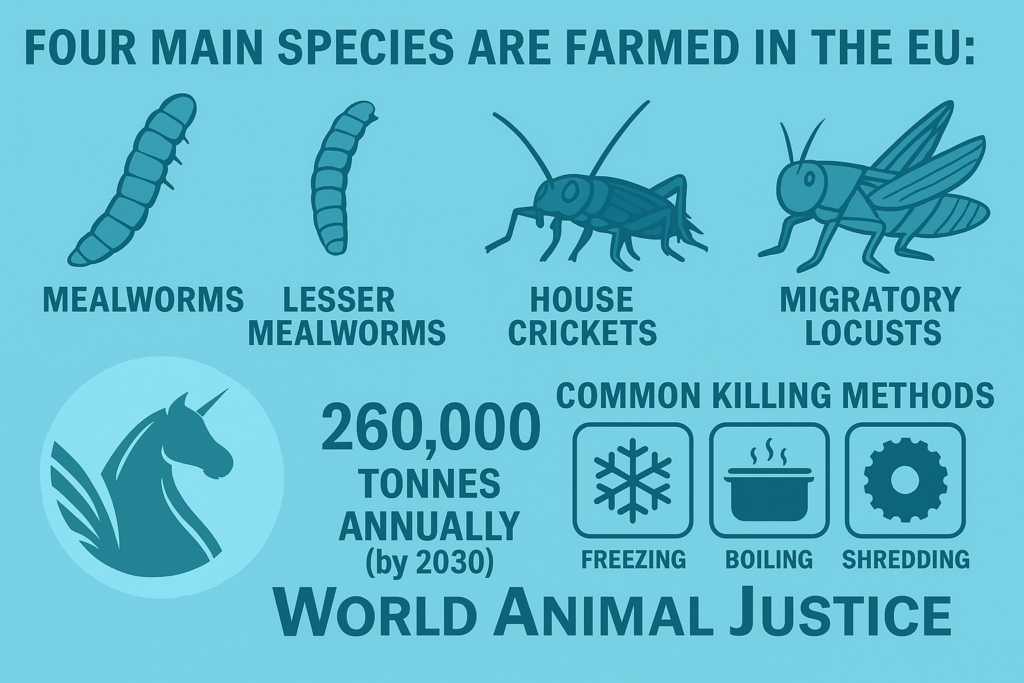
The EU has already authorised several insect species as novel foods for human consumption, including:
- Yellow mealworm (Tenebrio molitor)
- Lesser mealworm (Alphitobius diaperinus)
- House cricket (Acheta domesticus)
- Migratory locust (Locusta migratoria)
(See Regulation (EU) 2015/2283 on novel foods and subsequent implementing acts.)
For animal feed, additional species are widely used, such as the black soldier fly (Hermetia illucens), under EU rules on processed animal proteins. (Overview in IPIFF “Insects as Feed” factsheet.)
Industry projections suggest that edible insect-based products for human consumption may reach around 260,000 tonnes per year by 2030 in Europe, with even greater volumes when feed uses are included. (See IPIFF edible insects market factsheet 2020.)
On the ground, production is typically organised in intensive conditions:
- High-density plastic crates or trays
- Controlled heat and artificial light
- Automated feeding and ventilation systems
- Mass killing via freezing, boiling, or mechanical grinding of live insects
These methods are selected primarily for microbiological safety and cost-efficiency, not for minimising pain. At EU level, there are currently no specific welfare standards governing rearing or killing of insects for food or feed, leaving Member States free either to regulate or to ignore these issues. (See EU summary on protection of farmed animals, which explicitly excludes invertebrates.)
For consumer-facing products, insect-derived ingredients are increasingly used in snack foods, pasta, baked goods, protein bars and high-protein flours. The Novel Food Regulation ensures safety and some labelling, but does not guarantee prominent, consumer-salient labelling that would allow those who object to insect use to avoid such products. (See Regulation (EU) 2015/2283.)
4. The EU Legal Framework: A Protection Gap
From an animal-law perspective, the regulatory architecture around insects is strikingly asymmetric:
- Food law
Regulation (EU) 2015/2283 on novel foods treats whole insects and insect preparations as “novel foods”, focusing on safety and consumer information but remaining silent on welfare. (See Regulation (EU) 2015/2283.) - Feed law
Regulation (EU) 2017/893 and related instruments allow specific insect species to be used as processed animal protein in aquaculture, poultry and pig feed, again without welfare-specific provisions. (Summary in IPIFF insects-as-feed factsheet.) - Farm animal welfare law
Council Directive 98/58/EC on the protection of animals kept for farming purposes applies to vertebrates (including fish, reptiles and amphibians) but expressly excludes invertebrate animals. (See Directive 98/58/EC.) - Animals used for scientific purposes
Directive 2010/63/EU covers vertebrates and live cephalopods, but does not extend to insects; nevertheless, its recitals and annexes recognise pain, suffering and lasting harm as central criteria and embed the Three Rs (replacement, reduction, refinement). (See Directive 2010/63/EU.)
Consequently, billions of insects are covered by detailed rules on food safety and market authorisation but fall completely outside EU animal-welfare law. They are also typically counted in official statistics by biomass (tonnes) rather than by individual animals, which further obscures the scale of their use and of the pain risked. (Eurostat overview in “Agricultural production – livestock and meat”.)
For animal lawyers, this constitutes a classic protection gap: a large and expanding category of animals exposed to human use on an industrial scale, governed almost exclusively by market and sanitary law.
5. Plant-Based Proteins as a Legally Safer Alternative
The FAO’s landmark report “Edible Insects: Future Prospects for Food and Feed Security” frames insects as a promising sustainable protein source, with potential benefits for land use and climate. (See FAO 2013 report.)
However, life-cycle assessments consistently show that plant-based proteins (e.g. legumes, soy, pulses) have substantially lower greenhouse-gas emissions and land-use footprints than animal products, including many insect-based proteins in realistic systems. For policymakers seeking to meet climate targets without creating new large-scale risks of animal pain, incentivising plant-based proteins is legally and ethically more straightforward. (Overview in FAO “Edible Insects”.)
6. Executive Abstract for Animal Lawyers
Insect farming is rapidly expanding under an EU legal framework that regulates insects as food and feed but does not recognise them as sentient or grant them dedicated welfare protection. Scientific evidence increasingly supports insect sentience, or at least a substantial risk of sentience, sufficient to trigger the precautionary principle. Meanwhile, mass-rearing and killing methods are designed around efficiency, with little or no consideration of pain.
From a legal standpoint, this misalignment between scientific evidence, ethical commitments in EU primary law (Article 13 TFEU), and the current secondary legislation constitutes a serious incoherence. To restore legal consistency, the EU should: (1) recognise the sentience of certain invertebrates; (2) adopt minimum welfare rules for rearing and killing insects; (3) ensure transparent labelling of insect-derived ingredients; and (4) prioritise plant-based protein development as a lower-risk alternative under precaution.
7. Strategic Recommendations for EU Institutions and Litigators
- Clarify that Article 13 TFEU extends, in principle, to sentient invertebrates
Advocate that recognition of animals as “sentient beings” in Article 13 TFEU must evolve with the scientific evidence and cannot be read as limited to vertebrates where sentience is credibly indicated for invertebrates. (See Article 13 TFEU reference.) - Adopt a specific EU instrument on invertebrate welfare
Call for a Directive on the protection of certain sentient invertebrates used in farming, food and feed production, modelled in part on Directive 98/58/EC and Directive 2010/63/EU, but tailored to insect biology. (See Directive 98/58/EC.) - Define humane killing methods for insects and prohibit high-pain methods
Require that insects be rendered rapidly insensible by scientifically validated methods before killing, and prohibit practices such as boiling or grinding live insects where there is a substantial risk of intense pain. - Mandate clear, consumer-salient labelling of insect-derived ingredients
Ensure that any use of insects in food is clearly indicated on front-of-pack labelling, enabling consumers to exercise moral and religious choices. - Integrate insect welfare into the EU Green Deal and Farm to Fork Strategy
Position insect welfare explicitly in future revisions of the Farm to Fork and animal welfare legislative package, aligning it with climate and biodiversity objectives. (Background in Farm to Fork Strategy overview.) - Shift funding toward low-risk alternatives
Redirect innovation support from large-scale insect mass-production toward plant-based and cellular proteins, which do not require exposing potentially sentient animals to pain risks. (Policy context in FAO “Edible Insects”.)
8. Model EU Directive on Insect Welfare (Draft for Discussion)
Proposal: EU Directive on the Protection of Certain Sentient Invertebrates Used in Farming and Food Production
Article 1 — Subject Matter
This Directive establishes minimum standards for the protection of sentient invertebrates, including crickets, mealworms, locusts and similar species, during farming, handling, transport and killing.
Article 2 — Recognition of Sentience
Member States shall recognise the sentience of the invertebrate species covered by this Directive and shall ensure their welfare in accordance with Article 13 TFEU. (See Article 13 TFEU.)
Article 3 — Minimum Standards
Member States shall ensure that at least the following conditions are met:
- Housing density shall be limited to prevent overcrowding and shall allow insects to perform species-specific behaviours;
- Species-appropriate substrate, temperature, humidity and lighting shall be provided;
- Killing methods that cause severe or prolonged pain to live insects, including boiling or mechanical destruction of live animals without prior effective stunning, shall be prohibited;
- Insects shall be rendered rapidly insensible by a scientifically validated humane method before killing;
- Insect farm operators shall be subject to training and licensing requirements, including mandatory training in welfare-relevant biology and humane killing techniques.
Article 4 — Research and Review
The Commission shall, at least every five years, review scientific evidence on invertebrate sentience and welfare and, where appropriate, propose to extend the scope of this Directive to additional taxa. (Compare approach in Directive 2010/63/EU.)
Article 5 — Entry into Force
This Directive shall enter into force two years after its publication in the Official Journal of the European Union.
9. Annex: CAP Subsidies, Intensive Livestock and the European Climate Law
Although distinct from insect welfare, the expansion of insect farming is often justified by reference to climate mitigation and the need to decarbonise the Common Agricultural Policy (CAP). For animal lawyers, it is therefore important to understand the broader context.
9.1 Current CAP and Livestock Emissions
- The CAP 2021–2027 budget is approximately €386.6–387 billion. (See CAP 2023 factsheet.)
- Recent analyses suggest that around 80% of CAP support effectively benefits livestock production or feed crops, once grassland and feed-support measures are included. (See “Leveraging the Common Agricultural Policy to accelerate livestock emission reductions”.)
- Agriculture accounts for roughly 11–13% of total EU greenhouse-gas emissions, with livestock responsible for about 65% of agricultural emissions, mainly methane and nitrous oxide. (See EEA sector analysis 2025 and Oeko-Institut agriculture paper 2024.)
Eurostat data indicate that in 2023–2024 the EU maintained:
- ~133 million pigs
- ~72–74 million bovine animals
- ~67 million sheep and goats (combined)
- ~370+ million laying hens
while around 6 billion broiler chickens are raised and slaughtered each year. (See Eurostat livestock news 2024, Eurostat livestock news 2025, EFSA laying hens 2023 and broiler welfare report.)
Taken together, this implies well over 7 billion land animals raised and killed annually in the EU, the majority in intensive systems.
9.2 The European Climate Law and Legal Levers
Regulation (EU) 2021/1119 (the European Climate Law) makes the Union’s 2050 climate-neutrality objective and the intermediate 2030 target of at least –55% net GHG reductions legally binding. (See European Climate Law summary.)
Combined with:
- Article 191 TFEU (precautionary principle and high level of environmental protection), and
- State-aid rules (Article 107 TFEU and related jurisprudence),
this framework provides a basis to argue that continuing to allocate the vast majority of CAP subsidies to high-emission livestock systems, without a credible transition pathway, risks incompatibility with binding climate targets. (Legal analysis in Ecologic/EDF 2025.)
From a litigation and advocacy perspective, this enables:
- Evidence-building on lifecycle emissions per euro of subsidy;
- Strategic complaints to DG Competition on state aid to highly emitting sectors;
- Arguments before the CJEU that future CAP regulations must be interpreted (and, if necessary, annulled or amended) in light of the European Climate Law and the precautionary principle.
Closing Note
For animal lawyers, insects pose both a challenge and an opportunity. The challenge is to integrate rapidly evolving science on invertebrate sentience into a legal system that has historically centred vertebrates. The opportunity is to use core EU principles — sentience recognition, the precautionary principle, climate obligations and internal market coherence — to build a more consistent, future-proof framework for all sentient animals.