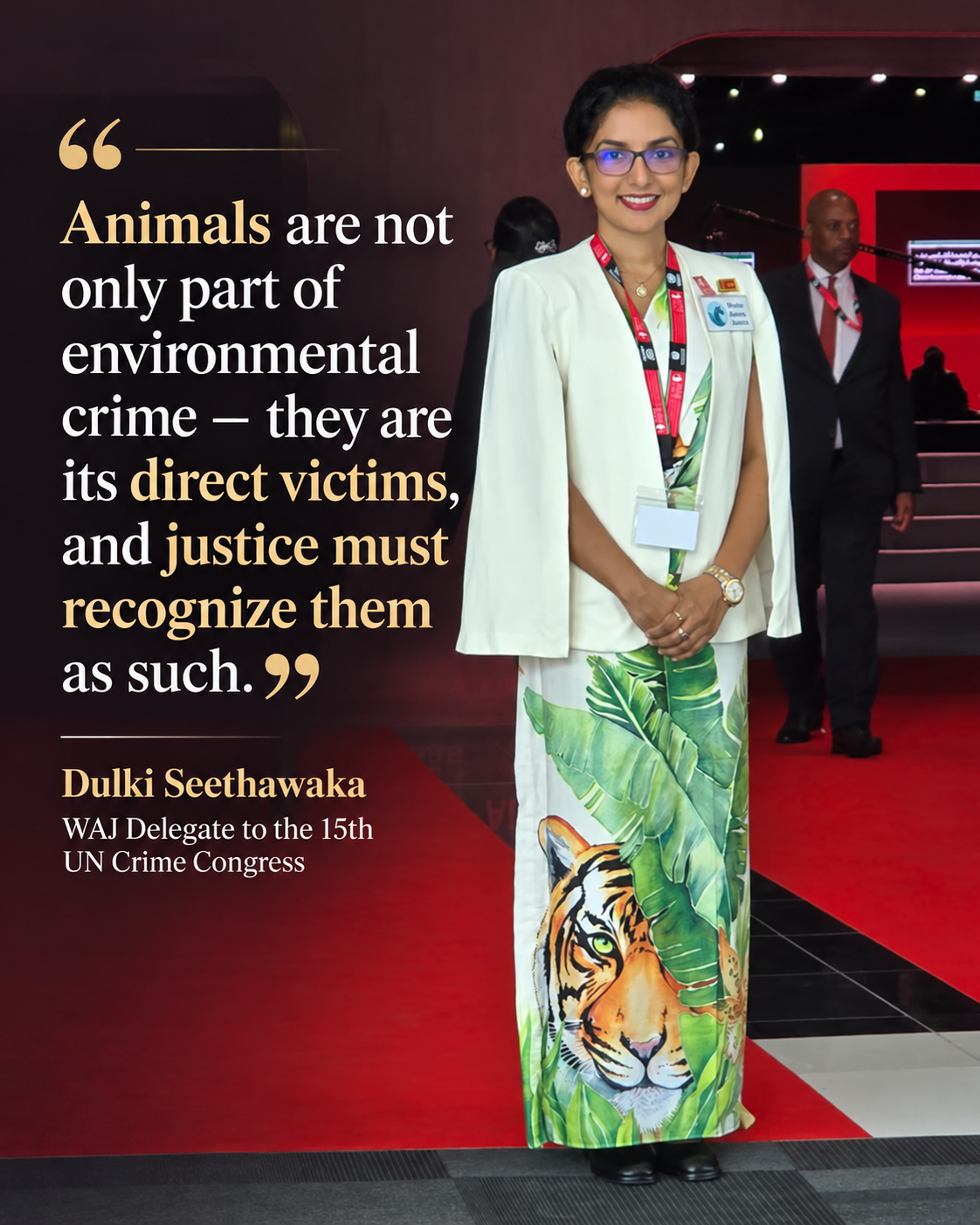

- Where do animals stand in the global fight against transnational organized crimes?
At the 15th UN Crime Congress in Abu Dhabi, environmental crime, wildlife trafficking and transnational organised crime took centre stage. But one crucial question remained: Are animals finally being recognised as victims in their own right?
-> In this compelling blog, Dulki Seethawaka, World Animal Justice’s official delegate, shares her firsthand reflections on the progress made, the critical gaps that remain, and the urgent need to move beyond protecting animals as resources towards recognising them as sentient beings deserving of legal protection and justice.
Authored by Dulki Seethawaka, World Animal Justice’s official delegate to the 15th UN Crime Congress (UNCC15) in Abu Dhabi (26 Sept-1 Oct 2026)
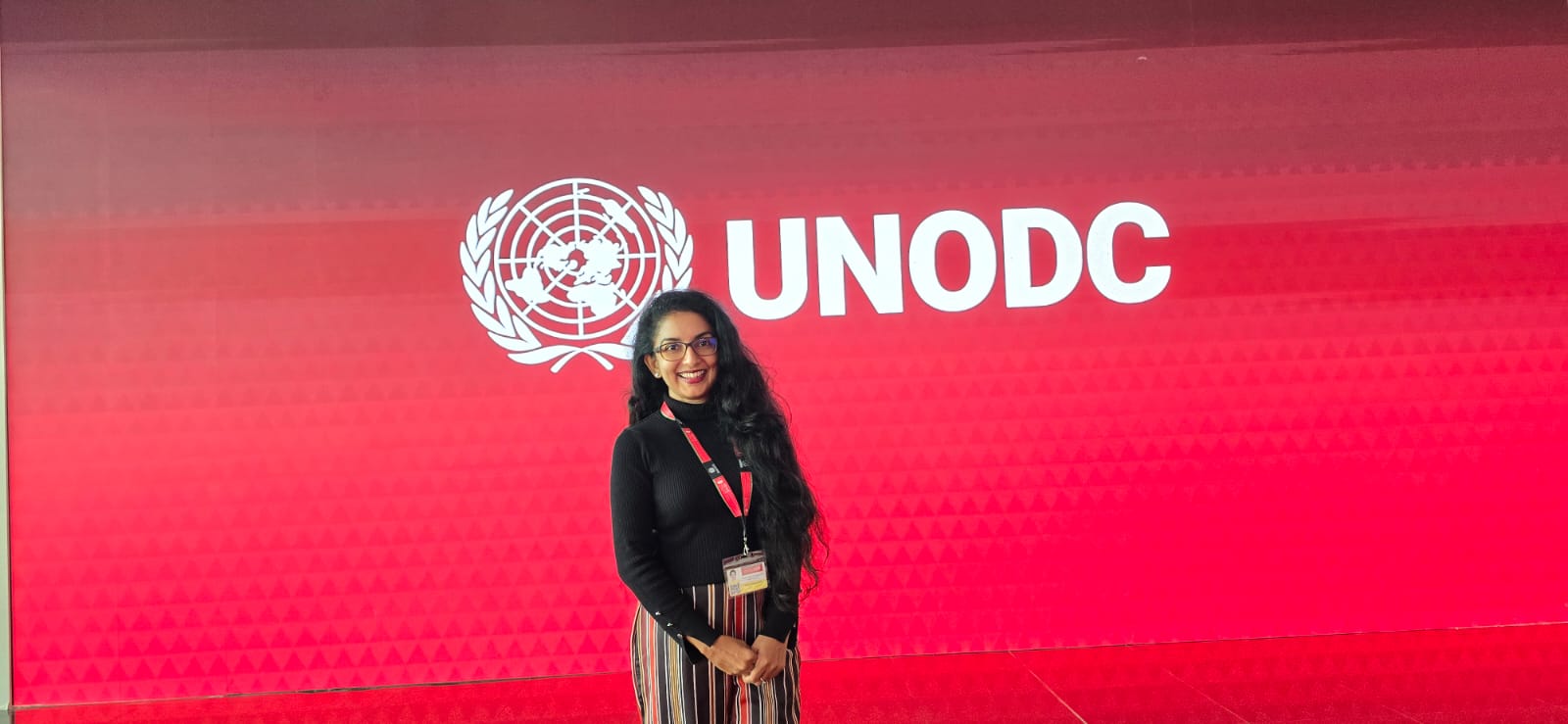
When I arrived in Abu Dhabi for the 15th United Nations Congress on Crime Prevention and Criminal Justice, held from 26 September to 1 October 2026, I was representing World Animal Justice as its official delegate.
I carried one question with me through every session I attended: how is the international community confronting crimes that affect the environment, and where do animals sit within that response?
The Congress was vast, so I chose to focus on sessions addressing wildlife trafficking, transnational environmental crime and their connections with organised criminal networks—issues at the heart of World Animal Justice’s advocacy. Over six days, these discussions took me from international legal frameworks and the case for an additional protocol to the UN Convention against Transnational Organized Crime (UNTOC), to the national security threats posed by wildlife trafficking in South Africa; from the Mediterranean as a transit and smuggling route and the role of the shipping industry, to illegal fishing and criminal activities across the fisheries value chain; and from the Gulf region as both a transit point and a destination market for wildlife products and exotic pets, including through online markets, to the role of civil society in strengthening international cooperation, and finally to questions of access to justice and support for victims. Throughout these discussions, I was particularly attentive to a question central to WAJ’s mission: whether animals themselves were being recognised as victims of these crimes, rather than merely as commodities, natural resources or objects of illegal trade.
What gave me hope
There was a great deal to learn from, and much of it was encouraging. Environmental crime was spoken of with real seriousness, as a form of transnational organised crime that affects livelihoods, revenues, governance and the rule of law. Speakers in the “Closing the Gaps” sessions argued for an additional protocol to the UN Convention against Transnational Organized Crime. At the high-level thematic meeting, ministers and heads of institutions agreed that no single country or institution can tackle these crimes alone, and the Abu Dhabi Call to Action was proposed to sustain that momentum.
Some sessions opened my eyes to the scale of the problem. The illegal fishing session showed how many different crimes are committed along the fisheries value chain, and the shipping session was candid about how hard it is for the industry itself to control wildlife trafficking. Compared with previous Congresses, I observed a noticeably greater focus on environmental crime, with wildlife trafficking and illegal fishing recognised directly as crimes affecting animals. That is progress, and it reflects the persistence of civil society and of States committed to the issue.
Hearing WAJ’s research in the room
Much of what I heard echoed the research WAJ published ahead of the Congress, and listening to the sessions with those documents in mind sharpened both.
The WAJ expert report Animals and Crime Convergence, directed by Dr Sabine Brels with Dr Meganne Natali and Luis C. Sarmiento, starts from a simple premise: animal exploitation is not isolated. It intersects with broader transnational organised crime, yet animals remain largely the invisible victims of global criminal networks. The report describes wildlife trafficking as frequently embedded in diversified criminal portfolios. It cites figures suggesting that around 40% of criminal groups engaged in wildlife trafficking are also involved in other illicit activities, particularly drug trafficking, and it describes shared shipments, overlapping routes and barter systems such as abalone exchanged for methamphetamine in South Africa. Seen this way, a wildlife seizure is not only an environmental incident. It may be an early warning of wider criminal infrastructure.
The report also turns attention to the shipping industry, examining live animal export, a subject that received no attention in the sessions I attended at the Congress. WAJ’s research demonstrates how livestock vessels, with their large numbers of animals, severe sanitary conditions and limited inspection capacity, can create conditions in which illicit cargo is difficult to detect. If transnational environmental crime is to be treated as a serious priority in crime prevention, the focus cannot be limited to wildlife trafficking and illegal fishing. It must also extend to the well-documented concerns surrounding live animal export.
The second publication, Dr Natali’s policy brief Beyond Trafficking: Rethinking Wildlife Crime as a Systemic Form of Exploitation, spoke directly to the push for an additional UNTOC protocol. International frameworks tend to treat wildlife crime as a cross-border trafficking and customs problem, which obscures the chain of domestic acts that sustains it: harvesting, processing, possession and local distribution. Where those upstream acts are treated as minor infractions, they may fall below the “serious crime” threshold under the UNTOC, and mutual legal assistance, extradition and asset recovery can stall. The brief proposed a harmonised, multi-verb definition of wildlife crime, and encouraged States to use current deliberations on a possible additional protocol to close the gap.
These were the very obstacles the “Closing the Gaps” speakers described, and what struck me was how consistently they returned to the same remedy. They stressed the need to adopt an additional protocol to the UNTOC that expressly recognises transnational environmental crimes, in order to curb wildlife trafficking. Their reasoning was practical rather than symbolic. Such a protocol would promote greater commonality in criminalisation, so that conduct treated as a serious offence in one country is not a minor infraction in the next. It would strengthen international cooperation, and it would enable more effective financial investigations and asset recovery. It would also address the serious crime threshold and dual-criminality obstacles that currently allow offenders to exploit differences between legal systems.
The speakers also framed the protocol as a matter of timing. The 13th UNTOC Conference of the Parties was presented as an opportunity to close the gaps, and the call was for States to act on it. Their argument rested on a point made throughout the sessions: that environmental crime is not only an environmental harm but a form of transnational organised crime, affecting livelihoods, revenues, governance and the rule of law. Seen in that light, a dedicated protocol is less an additional instrument than a long-overdue recognition of what these crimes already are. For me, it was reassuring to hear the same conclusion reached from two directions: through the speakers’ experience of enforcement, and through the legal analysis in WAJ’s research.
What left me perplexed
Yet one session in particular stayed with me. In the session on wildlife trafficking in the Gulf region, the emphasis was on properly regulating the wildlife trade, through engagement with conservation institutions and initiatives such as the Behavior Change Working Group under consideration at the United for Wildlife MENA Chapter and the IUCN Behavior Change Task Force. I found this somewhat perplexing. Rather than advocating a complete prohibition of the trade, grounded in the recognition of animals as sentient beings, the discussion centred on how the trade can be better regulated.
Behaviour change initiatives address consumer demand, which the speakers themselves identified as a driver of the problem, alongside online markets. But in my view, an approach built on regulation and demand management takes the commodification of animals as its starting point. It asks how many animals may be traded, by whom and under what conditions, rather than whether sentient beings should be treated as products at all. It also places heavy reliance on enforcement capacity, which the sessions I attended repeatedly described as strained. It reflects a broader tension between regulating animals as commodities and protecting them as individuals with intrinsic worth.
I saw the same pattern elsewhere. The closing ceremony focused largely on transnational crimes affecting people, with comparatively little attention to the environment or to animals. The Abu Dhabi Declaration, the Congress’s principal political outcome document, touches upon crimes that affect the environment without emphasising the animals who are directly harmed by them. The most specific commitment on environmental crime to emerge from the Congress, the Abu Dhabi Call to Action, is voluntary and non-binding. And although speakers at the “Closing the Gaps” sessions stressed the need for an additional UNTOC protocol, calls for States to launch negotiations on one were still being made, which suggests the question remained open. Environmental crime was prominent across the programme, but it has yet to be fully embedded in binding commitments, and animals as victims in their own right remain largely absent from them.
The official theme of the Congress was “Accelerating crime prevention, criminal justice and the rule of law: protecting people and planet and achieving the 2030 Agenda for Sustainable Development in the digital age”. It invites a simple question. What is the planet without its environment, and what is the environment without the animals within it? The own description of the Congress speaks of protecting individuals and communities, as well as the environment, from the adverse effects of crime, yet animals go unmentioned. Animals are not incidental to ecosystems. They are part of what makes a forest, a river or an ocean a living system rather than a collection of resources. If the planet is to be protected in any meaningful sense, the animals who inhabit it must be recognised as part of that protection, and not only as commodities to be regulated, evidence to be seized or revenue to be recovered. A justice system that speaks of protecting “people and planet” while treating the animals harmed by wildlife trafficking and illegal fishing as an afterthought leaves its own theme incomplete.
What I take home
Much of the discussion at the 15th United Nations Crime Congress remained anthropocentric. Animals and ecosystems appeared mainly as commodities to be regulated, resources to be protected or revenue to be recovered, rather than as sentient beings and as victims in their own right. This is what I was there to listen for, and it is the argument at the heart of WAJ’s Policy Declaration for the Congress: that animals are directly harmed within transnational criminal systems and should be recognised as such.
I left having learnt a great deal, and hoping that future Congresses will embed a more eco-centric approach to preventing transnational environmental crime, one that begins with the harm done to nature and to the animals within it. The 16th Congress will be hosted by Uzbekistan in 2031. The attention that wildlife trafficking and illegal fishing received in Abu Dhabi shows that the door is opening, and I am hopeful that by 2031 animals will be standing firmly inside it.
Protecting nature and the animals within it is not separate from crime prevention. It is part of how we build a justice system that sees the full extent of the harm.
My sincere gratitude to World Animal Justice and Dr Sabine Brels for this once-in-a-lifetime opportunity.