


End the Cage Age: From Citizens’ initiative to Courtroom
Executive Summary
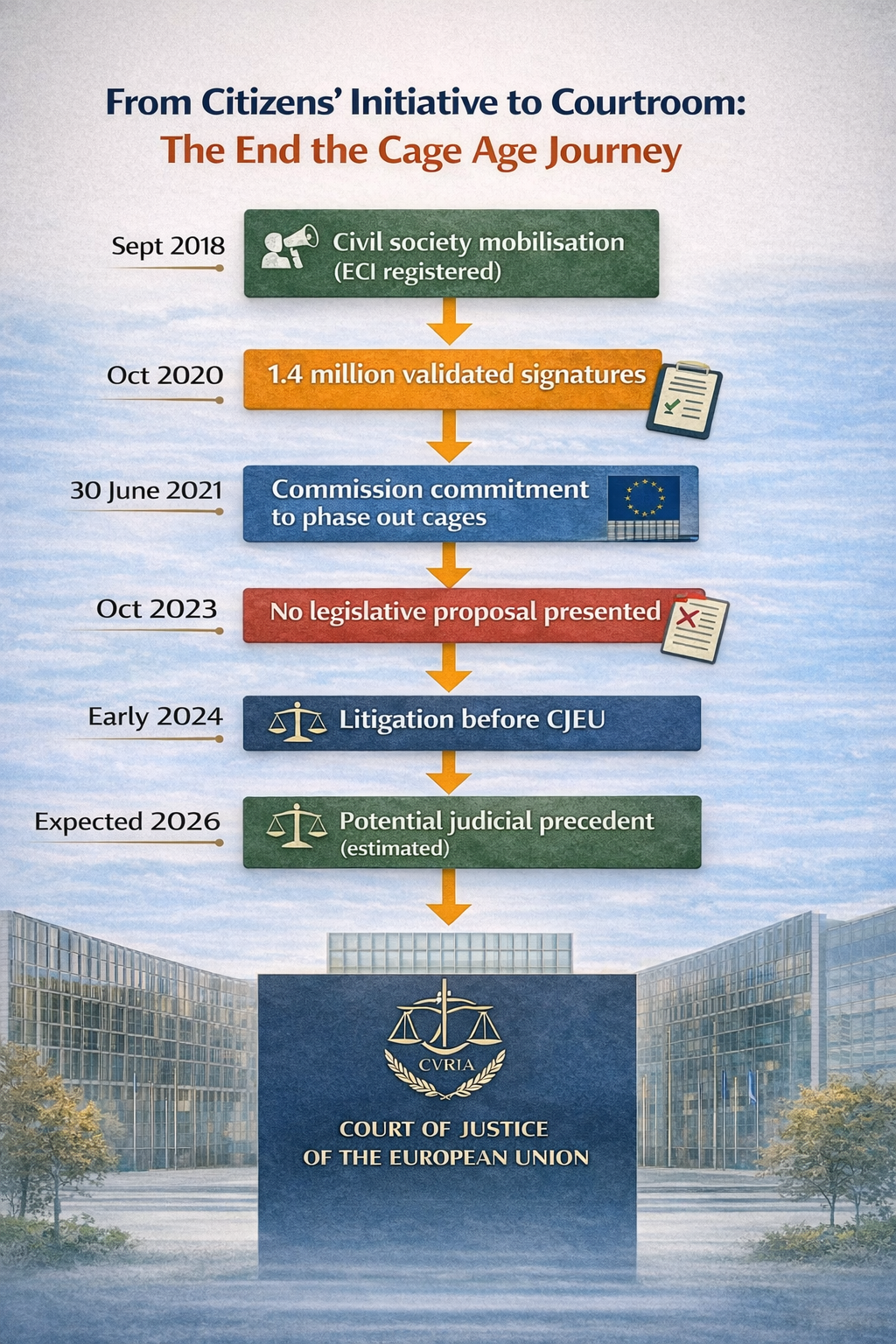
The European Citizens’ Initiative End the Cage Age mobilised 1.4 million citizens across Europe to call for the phase-out of cages for farmed animals. In 2021, the European Commission publicly committed to proposing legislation by 2023 — yet no proposal was presented.
The case is now before the Court of Justice of the European Union, raising a crucial question: when the Commission makes commitments after a successful citizens’ initiative, must it follow through?
The Court’s decision could shape the future effectiveness of the European Citizens’ Initiative as a tool for democratic participation and policy change in the EU.
Introduction
The recent 5 March 2026 hearing before the Court of Justice of the European Union (CJEU) provides a timely opportunity to examine a crucial moment for both animal welfare and EU participatory democracy.
The European Citizens’ Initiative (ECI) End the Cage Age is one of the largest cross-border mobilisations for farmed animals in EU history. It calls for the gradual abolition of cages for several species across the European Union.
At the same time, the initiative exposes a deeper institutional question:
When the European Commission publicly commits to act following a successful ECI, does that commitment have real legal consequences — or is it only a political promise?
This blog summarises key findings from research on the End the Cage Age initiative and explains why a campaign supported by 1.4 million citizens has not yet resulted in legislation. It also highlights a crucial reality of the EU system:
ECIs do not directly create laws — they trigger the political and legal battles that may eventually lead to them.
1. A Landmark Citizens’ Initiative
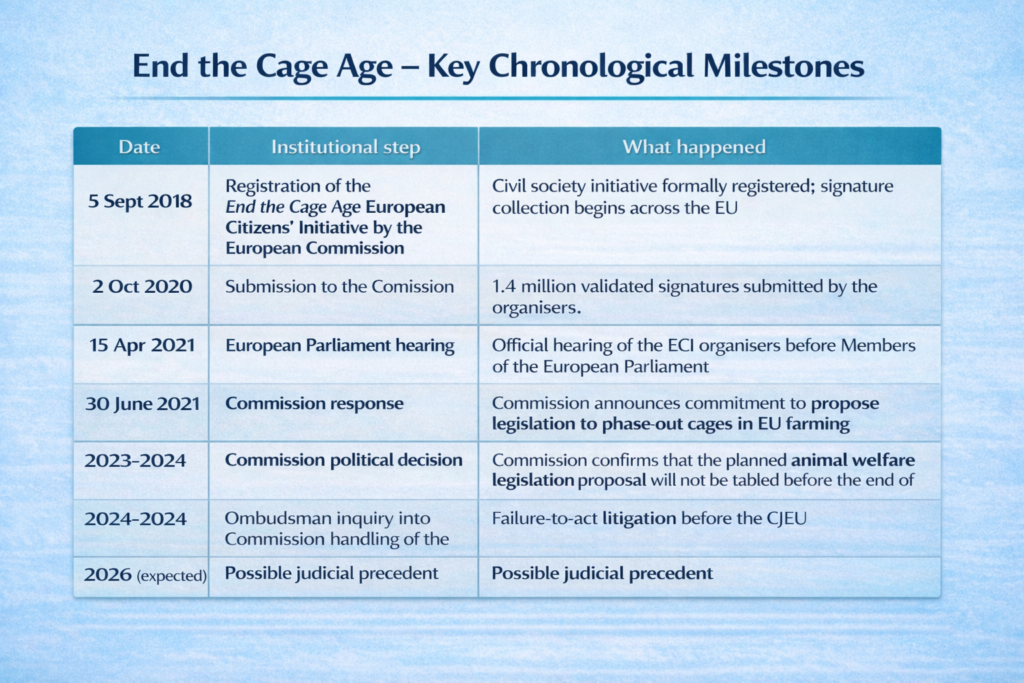
Launched in September 2018, End the Cage Age brought together a broad coalition of animal protection organisations coordinated by Compassion in World Farming.
The initiative called on the European Commission to ban cages for several farmed animals, including:
- laying hens
- rabbits
- pullets and broiler breeders
- ducks, geese and quail
- farrowing crates for sows
- sow stalls (where still allowed)
- individual calf pens
The proposal aimed to achieve:
- a progressive phase-out of cages
- species-specific transition periods for farmers
- financial and technical support during the transition
- equivalent standards for imported products
Within one year, organisers collected 1.4 million validated signatures, exceeding the required thresholds in more than seven Member States.
More than 170 NGOs joined the campaign, including:
- Compassion in World Farming
- Eurogroup for Animals
- Animal Equality
- LAV (Italy)
- foodwatch international
- FOUR PAWS
The campaign succeeded thanks to several structural strengths:
- a clear and concrete legal demand
• a strong scientific foundation, reinforced by EFSA opinions (2022–2023)
• alignment with growing national welfare standards across Europe
• a large transnational coalition operating in 22 languages
Legally, the initiative was submitted under Regulation (EU) 2019/788, which allows citizens to contribute to shaping EU law — but not to legislate directly themselves.
2. From Commission Commitment to Legislative Inaction
On 30 June 2021, the European Commission issued a positive response to the initiative.
The Commission committed to:
- propose legislation to phase out cages for the species covered by the ECI
- include this reform in the revision of EU animal welfare legislation
- rely on EFSA scientific opinions and impact assessments
- support farmers through the Common Agricultural Policy
- explore equivalent welfare standards for imported products
The possibility of a 2027 implementation timeline was also mentioned.
At the time, this appeared to be a major breakthrough.
However, no legislative proposal was tabled by the end of 2023, despite the Commission’s earlier commitment.
As a result, in March 2024, the citizens’ committee launched legal proceedings before the CJEU.
The action seeks:
- clarification of the Commission’s obligations
- a clear timetable for legislative action
- access to internal Commission documents related to the initiative
This case is legally significant because the Court cannot replace the Commission in drafting legislation. However, it can determine whether the Commission respected its obligations under EU law.
In particular, the Court may examine:
- compliance with the ECI Regulation
- the meaning of Article 13 TFEU, which recognises animals as sentient beings
- the legal value of commitments made by the Commission after a successful ECI
3. Why Has No Legislation Been Adopted Yet?
The situation creates a striking paradox.
The initiative had:
- 1.4 million citizens supporting it
- strong scientific evidence
- broad NGO backing
- growing national policy trends
Yet it still has no legislative proposal.
The explanation lies in the institutional design of ECIs.
Under EU law:
- the Commission retains the monopoly of legislative initiative
- ECIs require the Commission to consider a proposal and respond publicly
- but they cannot force the Commission to legislate
Several additional factors contribute to delays:
- complex impact assessments
- economic implications for farming sectors
- trade considerations
- competing legislative priorities
- shifting political dynamics within EU institutions
In other words:
A successful ECI places an issue on the EU agenda — but it does not guarantee legislation.
4. ECIs as Triggers for Law-Making Battles
This leads to a crucial insight.
The European Citizens’ Initiative is not a direct law-making instrument.
Instead, it functions as a trigger for broader institutional processes, including:
- political negotiations
- legislative advocacy
- public mobilisation
- strategic litigation
The End the Cage Age initiative illustrates this dynamic clearly.
The campaign:
- placed cage-free farming on the EU political agenda
- secured formal commitments from the Commission
- generated scientific and policy debate
- ultimately led to litigation before the CJEU
In doing so, it demonstrates how ECIs operate within — and challenge — the EU’s institutional framework.
5. What Comes Next for End the Cage Age?
Despite current delays, the broader policy context suggests that cage-free farming remains on the EU agenda.
On 19 February 2025, the EU adopted a new Vision for Agriculture and Food, in which the Commission reaffirmed its intention to revise animal welfare legislation.
Current expectations suggest that proposals related to animal welfare could appear in late 2026.
Meanwhile, civil society continues to maintain political pressure.
The upcoming World Cage Free Day (25 March 2026) aims to keep the issue visible and sustain public mobilisation.
However, the most decisive development may come from the Court when it issues its judgment, likely by summer 2026.
The judgment in the pending case could significantly influence how ECIs function in practice.
6. The 5 March 2026 Hearing in Luxembourg
On 5 March 2026, the Court of Justice held a public hearing in Luxembourg concerning the Commission’s alleged failure to act.
Representatives of the citizens’ committee — supported by organisations including:
- Compassion in World Farming
- Eurogroup for Animals
- Animal Equality
- Ligue Anti Vivisection
argued that the Commission failed to honour its commitments made in 2021.
They emphasised that around 300 million farm animals in the EU are still kept in cages every year, often in conditions that prevent natural behaviour.
During the hearing, judges questioned both sides on:
- the interpretation of the ECI Regulation
- the legal value of the Commission’s commitments
- the absence of a clear legislative timetable
Outside the court, animal protection organisations reiterated a clear message:
the European Commission must present a concrete timetable to end cage farming.
Whatever the final judgment, the case has already become a major judicial test for the effectiveness of ECIs in the EU system.
Conclusion: A Judicial Test for the Future of the European Citizens’ Initiative
The End the Cage Age initiative highlights both the power and the limits of the European Citizens’ Initiative.
In EU law, the European Commission is not obliged to adopt legislation exactly as requested by ECI organisers, nor within a fixed deadline. However, in its 30 June 2021 communication, the Commission went further than a simple political reply: it publicly committed to proposing legislation by the end of 2023 to phase out cages for the species covered by the initiative.
Because no proposal was presented, the case now before the Court of Justice of the European Union raises a key legal question:
When the Commission makes a clear commitment after a successful ECI, does it create a real obligation to act — or only a political promise?
The Court’s answer will be important not only for animal welfare but for the future effectiveness of the ECI mechanism itself.
Possible CJEU Decisions
1️⃣ The Court strengthens the procedural force of ECIs
The Court could decide that when the Commission gives a clear and positive response to a successful ECI, it must:
- either follow the legislative roadmap it announced,
- or formally explain and justify why it is changing course.
This would not remove the Commission’s monopoly of legislative initiative, but it would require greater accountability and transparency.
👉 In practice, this would mean ECIs could lead to stronger judicial scrutiny of Commission inaction, notably through Articles 263 and 265 TFEU.
2️⃣ The Court confirms the Commission’s broad discretion
The Court could also confirm that the Commission’s response to an ECI remains mainly political.
In that case:
- The Commission would remain free to delay, modify or abandon legislative follow-up,
- Even after expressing support for an initiative.
👉 ECIs would therefore remain agenda-setting tools, but without strong legal constraints on the Commission.
What This Means for Future ECIs
Whatever the outcome, End the Cage Age will likely become a key judicial precedent for the future of ECIs.
Possible implications include:
If the Court strengthens obligations:
- Stronger institutional accountability after successful ECIs
- Clearer expectations on Commission follow-up
- Greater role for judicial review when commitments are ignored
If the Court confirms wide discretion:
- ECIs remain powerful mobilisation and advocacy tools
- Real change will still depend on political pressure, campaigning and strategic litigation
A Stress Test for EU Participatory Democracy
End the Cage Age should therefore not be seen as a “failed” initiative.
Instead, it shows how ECIs work in practice:
- they mobilise millions of citizens,
- they place issues on the EU agenda,
- and they can trigger political, legal and advocacy battles to turn citizens’ demands into law.
The upcoming judgment of the Court will help determine whether ECIs remain mainly political mobilisation tools, or whether they evolve into stronger instruments capable of holding EU institutions accountable when they publicly commit to legislative action.
Either way, the case confirms one thing: In EU law, citizens can open the door — but only the Commission decides whether to walk through it.
Sources
- ECI initiative: End the Cage Age official ECI page
https://citizens-initiative.europa.eu/initiatives/details/2018/000004_en - Commission response: European Commission communication (30 June 2021)
https://ec.europa.eu/commission/presscorner/detail/en/ip_21_3297 - ECI Regulation: Regulation (EU) 2019/788
https://eur-lex.europa.eu/eli/reg/2019/788/oj - Ombudsman inquiry (important contextual source): https://www.eurogroupforanimals.org/news/end-cage-age-ombudsman-opens-inquiry-european-commissions-failure-act
- EFSA scientific opinions: https://www.efsa.europa.eu/en/topics/topic/animal-welfare
- EU Vision for Agriculture and Food (2025): https://agriculture.ec.europa.eu/common-agricultural-policy/cap-overview/vision-agriculture-and-food_en
– Photo credit: ALI/End the Cage Age Coalition
– Content credit: Blog based on the analysis from Typhaine Mestre, WAJ research volunteer (see full analysis below)