

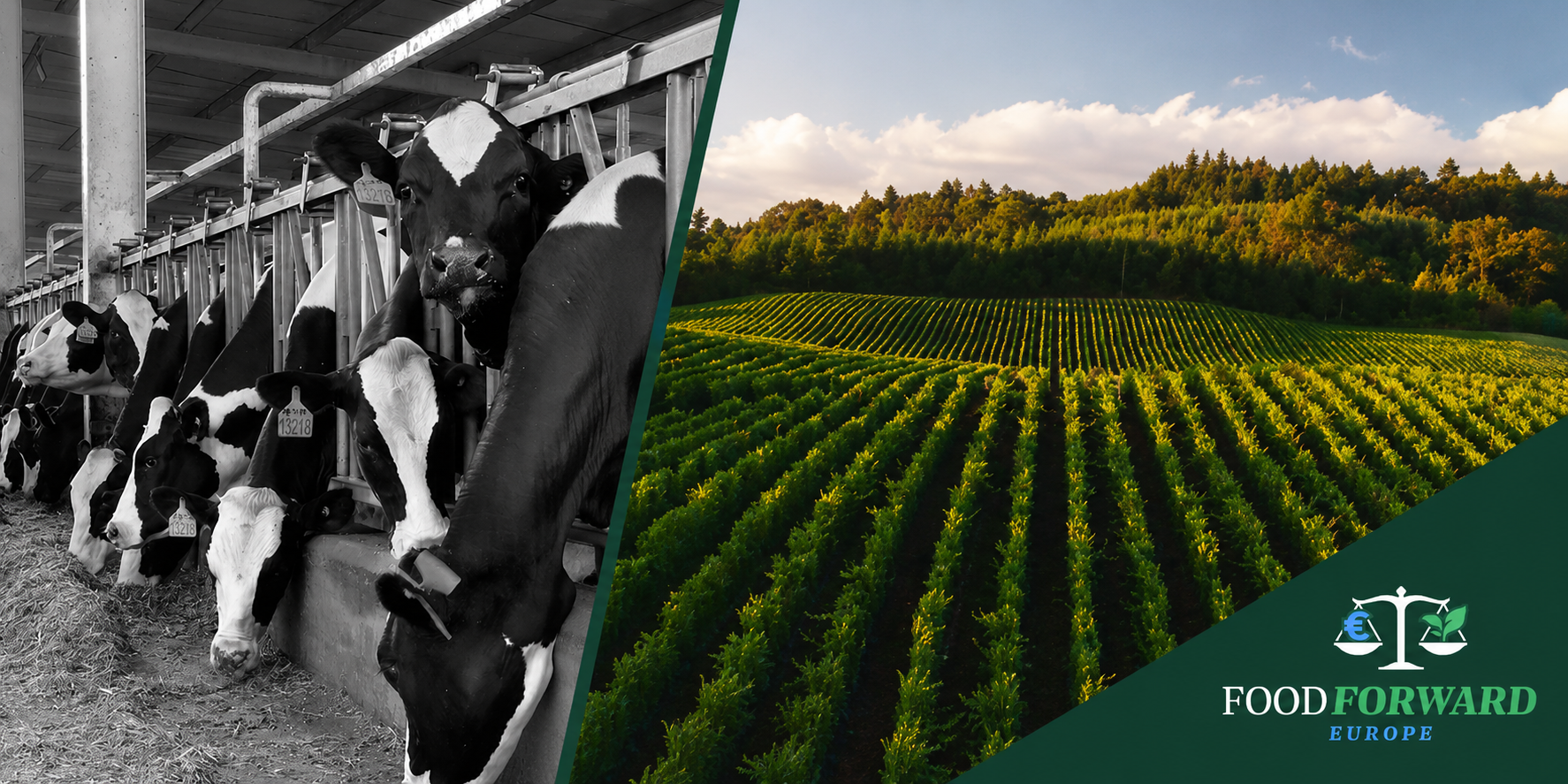
🌱 Food Forward Europe: Building a Legal Path Towards Fairer EU Agricultural Subsidies
🌍 What if European agricultural subsidies helped accelerate the transition towards a more sustainable food system instead of continuing to disproportionately support livestock production?
⚖️ This is the question at the heart of Food Forward Europe (FFE), a legal initiative launched by World Animal Justice in 2025 to address one of the structural drivers of intensive animal agriculture in Europe: the way EU agricultural subsidies are allocated.
🌱 FFE seeks to address the imbalance in EU agricultural support in favour of livestock production and advocate for substantially greater support for plant-protein crops for direct human consumption. Our objective is to help align European agricultural spending with the EU’s own commitments and legal obligations concerning climate change, environmental protection, animal welfare, public health and sustainable food systems.
🚀 From K4G to the successful launch of Food Forward Europe
🌟 Food Forward Europe was successfully developed through the Kickstarting for Good (K4G) incubator programme in 2025, with the support of ProVeg International, before being officially launched in November 2025. FFE was presented at the K4G Summit in Berlin by its co-heads Dr Sabine Brels and Alessandro Ricciuti. WAJ’s 2025 Annual Report documents this journey and FFE’s successful launch.
🎨 The initiative also benefited from invaluable in-kind support from Violet Studios, which helped build FFE’s visual identity, branding and website. This allowed the project developed through K4G to emerge as a dedicated European legal initiative with its own platform and identity.
🌿 During the first half of 2026, FFE then moved rapidly from launch to building the legal, scientific, political and civil-society foundations for systemic change.
⚖️ Building the legal case for reform
💶 At the centre of FFE’s work is a simple principle: public money should serve the public good.
🚜 Yet EU agricultural subsidies remain structurally skewed towards livestock production. FFE’s research highlights estimates that around 82% of CAP subsidies supporting food production benefit animal-based products, directly or indirectly, while plant-protein production for direct human consumption receives comparatively limited support.
🌍 This imbalance is increasingly difficult to reconcile with European commitments concerning climate mitigation, environmental protection, biodiversity, food security, animal welfare and the transition towards healthier and more sustainable food systems.
⚖️ FFE is therefore exploring how EU law itself can provide new avenues to challenge this imbalance, combining legal research, evidence gathering, policy advocacy, coalition building and, ultimately, strategic litigation.
📘 From research to concrete policy proposals
📚 A major milestone came in April 2026 with the publication of the first Food Forward Europe Report, “Future-Proofing the CAP: Rebalancing EU Subsidies Toward Plant-Based Production”.
📄 A shorter Executive Summary of the FFE Report is also available.
⚖️ This report provides a legal and policy assessment of how the EU’s Common Agricultural Policy (CAP) shapes food systems, exposing a misalignment between public spending and EU climate, environmental, animal welfare and food security objectives.
🐄 It shows how agricultural subsidies largely support livestock and feed-dependent production systems, while comparatively under-investing in plant-based proteins for direct human consumption.
⚠️ Crucially, the report also identifies legal risks and growing exposure to judicial scrutiny arising from this misalignment. It explores how EU climate, environmental and animal welfare obligations could provide important legal grounds for challenging agricultural policies that fail to adequately integrate these objectives.
🌱 To address this structural imbalance, FFE proposes the reallocation of 20% of CAP support towards plant-based production, helping strengthen EU food security, plant-protein autonomy and sovereignty while driving a structural transition towards a more sustainable European food system.
📝 Turning our recommendations into legislative amendments
🏛️ FFE has gone beyond identifying the problem. We have translated the policy recommendations set out in our report into concrete legislative amendment proposals to help shape the ongoing reform of the European Union’s Common Agricultural Policy.
📑 Our proposed legislative amendments address four key pieces of current draft EU legislation:
- CAP Regulation
- Common Market Organisation (CMO) Regulation
- National and Regional Partnership Fund (NRPF) Regulation
- Agriculture Simplification Omnibus package
🇪🇺 Together, these amendments seek to turn FFE’s core recommendations into concrete legislative changes — strengthening support for plant-based production, improving the alignment of EU agricultural spending with EU law and sustainability objectives, and creating stronger foundations for Europe’s plant-protein transition.
👉 Read FFE’s proposed legislative amendments to the current draft EU legislation: https://www.foodforwardeurope.org/report
🤝 These proposals are also supporting our engagement with Members of the European Parliament and other EU decision-makers. Several MEPs have expressed support for the direction of FFE’s proposals and our call for a fairer balance between livestock and plant-based production, creating an important bridge between our legal research and the legislative opportunities surrounding the next CAP.
🤝 Building a European coalition for CAP reform
🌍 Changing a system as large as the Common Agricultural Policy cannot be achieved by one organisation alone. Coalition building has therefore been central to FFE from the beginning.
🤝 FFE’s core partners bring together complementary expertise in animal protection, plant-based food systems, EU policy, law and advocacy. They include World Animal Justice (WAJ), ReFOOD, ProVeg International, the European Vegetarian Union (EVU), Green REV Institute, L214, ObSAF and the University of Southampton Legal Clinic.
🎥 In May 2026, FFE organised its first Food Forward Europe Webinar with a Food Systems Expert Panel, bringing together civil-society organisations and experts to examine how CAP reform could help Europe transition towards a fairer and more sustainable food system.
🌱 Participating organisations included World Animal Justice, Food Forward Europe, ReFOOD, ProVeg International, the European Vegetarian Union (EVU), Green REV Institute and L214, bringing perspectives spanning EU agricultural policy, animal protection, plant-based food systems and legal reform.
▶️ Watch the Food Forward Europe Webinar replay: https://www.youtube.com/watch?v=bTR52_Wx4jw
📢 From coalition building to a common call for reform
📣 Building on this collaboration, FFE launched the Joint Statement on Rebalancing CAP Support to Meet EU Law and Policy Commitments, transforming a growing network of organisations into a collective European call for reform.
🌍 The final Joint Statement was endorsed by more than 25 NGOs from 14 countries, bringing together organisations working across animal protection, food-system transformation, plant-based production, sustainability, health and related fields.
🌱 Together, the signatories call for EU agricultural funding to be rebalanced so that the next CAP better supports sustainable plant-based production and aligns public spending with European climate, environmental, animal welfare and food-system objectives.
👉 Read the final Joint Statement and discover the organisations supporting FFE’s call for reform: https://www.foodforwardeurope.org/
🏛️ Taking our proposals to European decision-makers
Research must translate into political and legal action. During the first half of 2026, FFE therefore moved beyond analysis to engage directly with European decision-makers on the future of the post-2027 CAP.
🤝 FFE and its partners engaged with Members of the European Parliament and their teams to present the case for greater CAP support for plant-based production, including our proposal to redirect at least 20% of relevant agricultural support towards sustainable plant-protein production for human consumption.
📝 Building on the recommendations developed in the FFE Report, concrete amendments reflecting FFE’s asks were prepared and proposed for tabling in the European Parliament, seeking to embed stronger support for plant-based production and better alignment of future agricultural funding with EU climate, environmental, health and animal-welfare objectives.
🌱 Encouragingly, several MEPs expressed support for the direction of FFE’s proposals and our call for a fairer balance between livestock and plant-based production. This political engagement represents an important bridge between FFE’s legal research and the concrete legislative opportunities surrounding the next CAP.
📑 The post-2027 CAP debate reinforces the urgency for reform
🏛️ These advocacy efforts take place against the backdrop of the European Parliament’s work on the future of EU agricultural policy, including its Report on the future of agriculture and the post-2027 Common Agricultural Policy (https://www.europarl.europa.eu/doceo/document/A-10-2025-0143_EN.html).
🌍 The need for greater alignment between CAP spending and the EU’s environmental and climate objectives has also been highlighted by the European Court of Auditors Special Report 20/2024, “Common Agricultural Policy Plans – Greener, but not matching the EU’s ambitions for the climate and the environment” (https://www.eca.europa.eu/en/publications/sr-2024-20).
⚠️ The Court’s findings are particularly relevant to FFE’s advocacy: while CAP Strategic Plans introduced greener elements, the Court concluded that they still do not match the EU’s climate and environmental ambitions. This provides further institutional evidence of the gap between the objectives Europe has set for itself and the way agricultural policy is implemented.
🤝 Building a European coalition
🌍 Changing a system as large as the Common Agricultural Policy cannot be achieved by one organisation alone. Coalition building has therefore been central to FFE from the beginning.
🌱 During the first half of 2026, FFE brought together organisations and experts working across animal protection, food-system transformation, sustainable agriculture, European law and public policy.
🎥 In May, FFE organised its first Food Forward Europe Webinar with a Food Systems Expert Panel, creating a dedicated space to discuss how agricultural funding can better support Europe’s transition towards a sustainable food system. The full webinar replay is available here: https://www.youtube.com/watch?v=bTR52_Wx4jw.
📣 The subsequent Joint Statement transformed this growing network into a collective policy call: public funding under the post-2027 CAP should be rebalanced to better serve European legal obligations and public-interest objectives.
📰 Growing recognition across Europe
📢 FFE’s work has already begun receiving attention beyond the initiative itself.
In May 2026, Italian organisation ReFOOD published an article highlighting FFE’s proposal that 20% of CAP subsidies should support plant proteins.
The release of the FFE Joint Statement was also featured in the Eurogroup for Animals Bulletin.
🗞️ FFE’s work additionally reached the wider European policy debate through a mention in POLITICO pro, an encouraging indication that the question of how EU agricultural subsidies are allocated is gaining visibility among EU policy stakeholders.
⚖️ Exploring new pathways through EU law
🇪🇺 FFE is not simply advocating for a policy preference. A central part of the project is investigating whether the current allocation of agricultural subsidies can be challenged through existing EU legal obligations.
🌍 European law contains potentially powerful legal hooks concerning binding climate targets, environmental protection and animal welfare, alongside broader European commitments concerning biodiversity, sustainable food systems and public health.
⚖️ FFE is therefore examining how these obligations interact with agricultural spending and whether failures to adequately integrate them into CAP implementation could ultimately provide the basis for strategic legal action before European courts, including potential litigation pathways leading to the Court of Justice of the European Union (CJEU).
🎓 This innovative approach was also presented in March 2026 at the AVA Academy in Berlin, where WAJ Founder and FFE Head Dr Sabine Brels led a session on “New Pathways in Animal Law and Policy Advocacy,” including emerging opportunities for EU legal action benefiting farmed animals.
🌱 EU policy is moving — and the timing matters
⏳ Developments at EU level during 2026 further demonstrate why FFE’s advocacy comes at a particularly important moment.
🐄 On 7 July 2026, the European Commission released its new EU Strategy on Livestock, setting out the Commission’s long-term direction for the resilience, competitiveness and sustainability of the livestock sector.
🌿 In parallel, the European Commission is advancing its work on European plant proteins and protein autonomy through its Protein Action Plan, aimed at scaling up sustainable domestic protein production, diversifying supplies and strengthening European protein value chains.
💡 The emergence of dedicated EU approaches addressing both livestock and European protein production strongly reinforces the timeliness of FFE’s advocacy. These developments place precisely the questions FFE has been raising — how Europe supports livestock, how it develops plant proteins, and how public agricultural funding can facilitate a sustainable transition — at the centre of the European policy agenda.
🌱 For FFE, the key question now is how these emerging strategies will translate into the post-2027 CAP and the allocation of public funding. Strengthening European plant-protein production will require not only strategic recognition, but adequate financial support capable of correcting the longstanding imbalance between livestock and plant-based production.
🚀 Why the next phase matters
⏰ The coming months and years will therefore be decisive for the future of European agricultural policy.
🇪🇺 As the EU prepares its next agricultural framework, Europe has a major opportunity to reconsider whether billions of euros in public funding should continue reinforcing forms of production that conflict with broader European climate, environmental, animal-welfare and public-health objectives.
⚖️ FFE aims to ensure that this debate goes beyond incremental policy reform. By combining EU law, strategic litigation, evidence-based advocacy, political engagement and coalition building, Food Forward Europe is exploring whether the legal system itself can become a driver of food-system transformation.
🌍 Our vision remains clear: European agricultural funding should help build a food system that works better for animals, people and the planet.
🌱 The first half of 2026 has been about building the foundations. The next phase will be about turning those foundations into a credible pathway for systemic legal and policy change.
👉 Discover Food Forward Europe, read our resources and learn more about our work: https://www.foodforwardeurope.org/